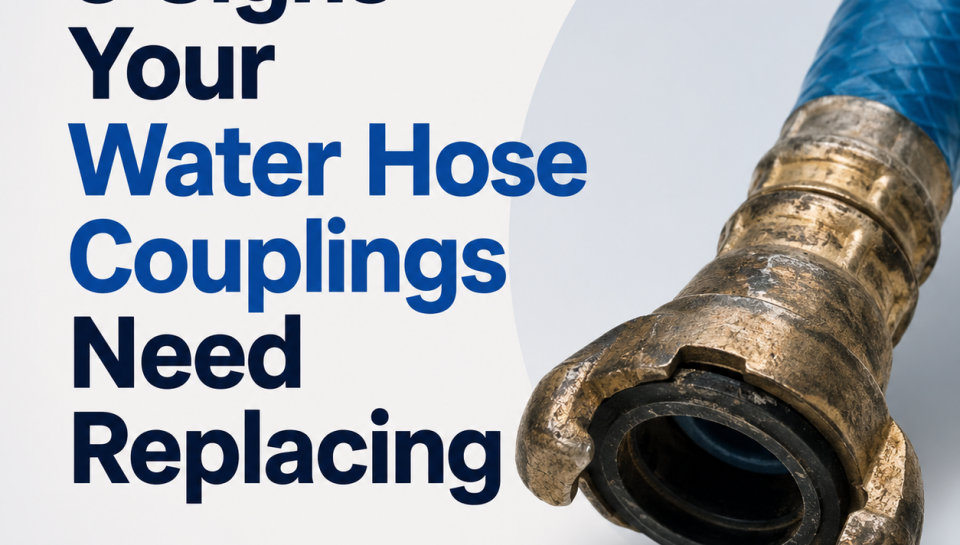
5 Signs Your Water Hose Couplings Need Replacing
Quick Answer
The five clearest signs a hose coupling needs replacing are a leak that keeps returning, rust or pitting on the body, trouble connecting or disconnecting it, a coupling that spins loosely on the hose, and a drop in flow or pressure at the joint. If you spot two or more of these together, replace the coupling.
Introduction
Is your hose coupling leaking or hard to connect? These are early warning signs. A failing hose coupling almost always shows signs before it breaks.
This guide covers the 5 clearest signs, what causes them, and when to repair versus replace.
Why Does My Coupling Keep Leaking After I Replace the Seal?
A repeat leak usually means the coupling body is worn, not the seal. This is the most common early warning sign.
Here is how it plays out. You see a drip. You replace the O-ring or washer. A few days later, the drip comes back.
When this happens, the sealing surface inside the coupling has likely worn down or warped. No new seal can sit flush against a damaged surface.
Why Is My Coupling Rusting or Pitting?
Rust and corrosion break down the metal surface, which stops the seal from working. This is not just a look problem.
Rust creates tiny gaps and rough patches on the metal. These gaps stop the seal from making full contact, which causes leaks.
In marine settings, this happens fast. Salt spray, humid dockside air, and salt water washdown all attack unprotected metal quickly.
If you work near the coast in the UAE, check your couplings for early rust more often than the manual suggests. Local heat and salt speed up the damage.
Why Is My Coupling Hard to Connect or Disconnect?
A stiff coupling usually means worn parts inside, not just dirt. But dirt is worth checking first.
A coupling that used to click on smoothly but now needs force is telling you something. This often comes from a worn locking part, grit buildup, or damaged threads.
Clean the coupling first and check for debris. Sometimes this alone fixes the problem.
If it is still stiff after cleaning, the internal parts have worn past a safe point. Forcing a stuck coupling can damage the hose end too.
Why Does My Coupling Spin or Wobble on the Hose?
A coupling that spins on the hose is a safety problem, not just a leak.
This usually means the clamp or crimp holding the coupling has failed or loosened. Under pressure, a loose coupling can blow off completely.
Do not keep using a hose assembly once you notice this. Replace the coupling before you use it again.
Why Do I Hear Hissing or Feel Weak Flow at the Joint?
A hissing sound or weak flow often means a leak you cannot see yet.
Sometimes there is no visible drip, but the flow feels weaker than normal. Or you hear a faint hiss at the connection point.
This points to a small internal leak. It often comes from a seal that has started to break down, or a slight misalignment inside the coupling.
Walk the line during routine checks. Listen at each joint. This is one of the fastest ways to catch a leak early.
Should I Repair or Replace My Coupling?
Use this simple rule to decide.
Repair the seal only if:
- The coupling body is not cracked or corroded.
- The threads are clean and undamaged.
- Only the O-ring or seal looks worn.
Replace the whole coupling if:
- You see rust, cracks, or pitting on the body.
- The threads are damaged.
- The crimp or clamp has loosened.
Trying to save a damaged coupling body usually costs more in the end. Repeat leaks, wasted fluid, and downtime add up fast.
How Long Do Hose Couplings Last?
There is no fixed lifespan for a hose coupling. Anyone who gives you one exact number is guessing.
Lifespan depends on the environment, how often you connect and disconnect it, and the material it is made from.
In dry indoor settings, a good coupling can last several years with little trouble.
In marine or coastal areas, salt exposure can cut that lifespan down a lot. This is why routine checks matter more than a fixed replacement date.
Conclusion
A failing hose coupling almost always gives warning signs first. Watch for repeat leaks, rust, stiff connections, wobbly fittings, and hissing sounds. Catching these early saves you from downtime, wasted fluid, and bigger repairs later.
If you need water hose couplings, quick release fittings, or hose clamps in Dubai, AKA Trade can help. Send us a photo of your old coupling and we will help you find the right match fast.
FAQs
Can I just replace the O-ring instead of the whole coupling?
Yes, if the coupling body and threads are still in good shape. This is the cheaper first step, as long as the leak stops for good.
Why does my coupling only leak when it is connected?
This usually means the seal fails under pressure. It looks fine when loose because there is no load on it yet.
How do I know if it is the hose or the coupling leaking?
Dry the connection, then pressurize the system. A leak right at the joint points to the coupling. A leak along the hose points to the hose itself.
What causes a hose coupling to corrode?
Constant moisture, salt water, and humid air cause corrosion. This is much faster in coastal and marine areas than dry indoor sites.
Why won’t my quick release coupling lock?
This is often caused by a worn locking part, trapped debris, or damaged threads. Clean it first, then replace it if the issue continues.
How often should I inspect my hose couplings?
Check couplings during every routine maintenance round. In marine or coastal settings, check more often due to faster corrosion.